How Stillmonk works
From the first screen to the first hard night. What the app does, in the order you meet it, and what is free and what membership adds.
Getting started
A short set of questions, about three minutes, one per screen: your age, where you are starting from (days you have already counted come with you), when the pull is strongest, what makes it stronger, what you have tried before, why you are climbing and where you want the climb to take you. From those you make a plan for the hard hour, and the app shows you its own screens with your answers in them.
Then you save your climb to an account with Apple, Google or email, so you can bring it to a new phone. After that you choose: Start free, or a membership with its price in your own currency shown first. Last, you choose where your answers live, on this phone only or in your private account.
If the pull is loud right now, the very first screen has a button that says "Feeling the pull? Breathe now." It needs no account and no answers, and the crisis line for your region sits under the breathing.
When an urge arrives
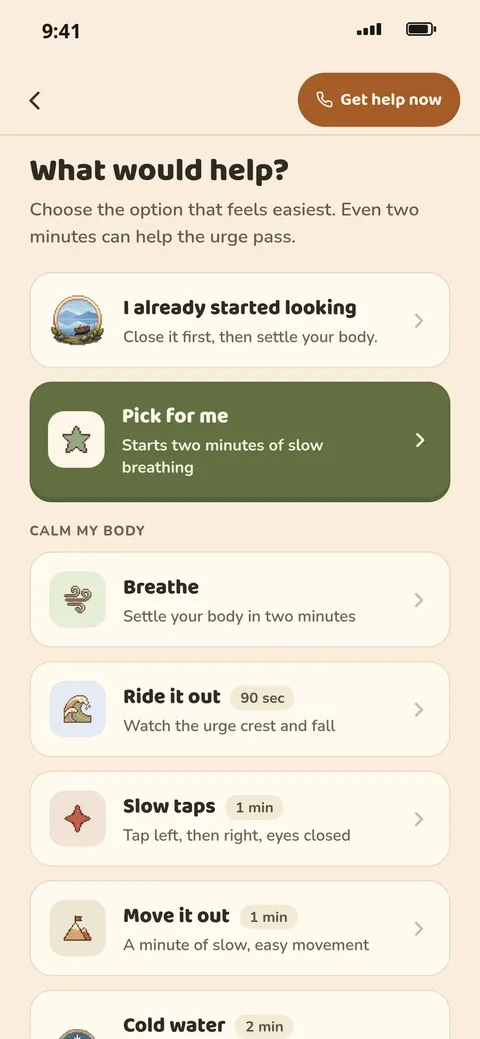
Home has one button for it. The plan you made for the hard hour sits at the top, then "Pick for me" for when choosing is too much, then the tools in groups:
- Calm my body. Breathe (in for four, hold for four, out for six), Ride it out (watch the urge crest and fall over about ninety seconds), Slow taps, and Move it out.
- Reach out. Call or text one of up to three people you trust, or talk to Sage.
- Shift my mind. Name it, Play it forward, and Why I started: the reasons you chose and, if you wrote one, a note from calm you.
- Step away for a while. A short walk, one song, a cup of tea, and other things that take you away from the phone.
Nineteen small things to do instead sit among those groups, like cold water or a quiet game of stacking stones, each guided or timed. When you finish, the app asks how it is now, and remembers on your phone what helped, so the menu puts what has helped you before first.
On the free plan the menu holds Breathe, Ride it out, Why I started and Call or text. Membership adds Sage and every other tool.
Every day
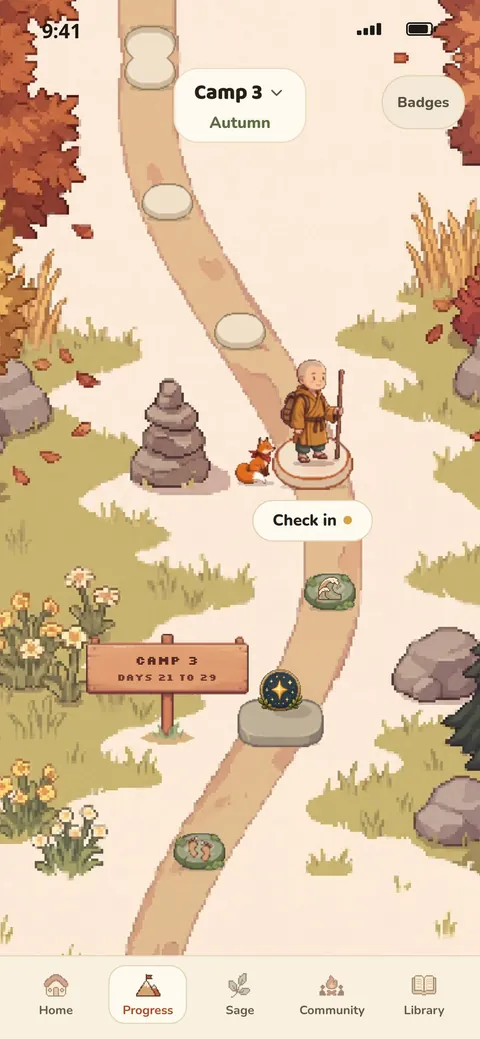
Home shows how long your climb has run, with the monk and the fox in that day's scene. The day count is the number that matters here. A short check-in asks how you are today. With a membership, each day on the trail also has a suggested reading from the Library: practices for the hard moment and the time before it, stories, and reflections.
Every clean day the monk climbs one stone further along a painted trail, through camps, places and seasons, for a whole year. Reminders are off until you turn them on.
If you slip
You tell the app with "I already slipped, what now?" near the top of the urge menu, or with Begin again in Settings. The day count starts over from today, and your longest climb and badges are kept. Nothing is taken away as a punishment. The screen is the same every time, and it never counts how often you have begun. It is free, like everything on this path.
The screen after it offers one small, kind thing for the next hour, like eating something warm or stepping outside, and the crisis line, quietly, for anyone the evening is heavy for. For the moment you have already started looking, the urge menu has its own door: close it first, then settle your body.
Sage, the AI guide
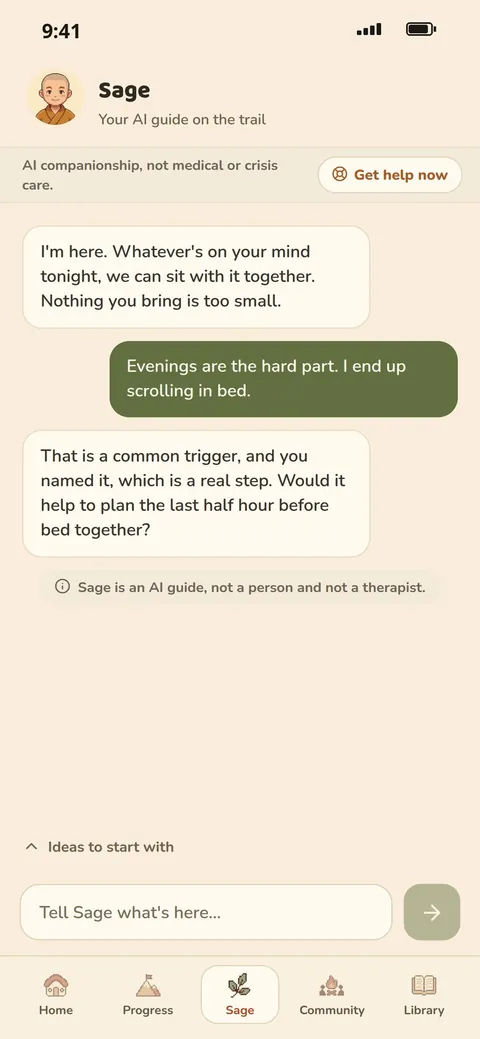
Sage is part of membership: a computer program you can talk to at any hour about urges, triggers, reasons and choices. It asks before your first message is saved or sent, and every chat starts with the line "Sage is an AI guide, not a person and not a therapist." "Get help now" sits at the top of every chat.
Sage has no memory of your day count or reasons. Its messages go to an AI model provider to write each reply. How Sage handles a crisis explains what happens when crisis words appear, and what the check can miss.
The community
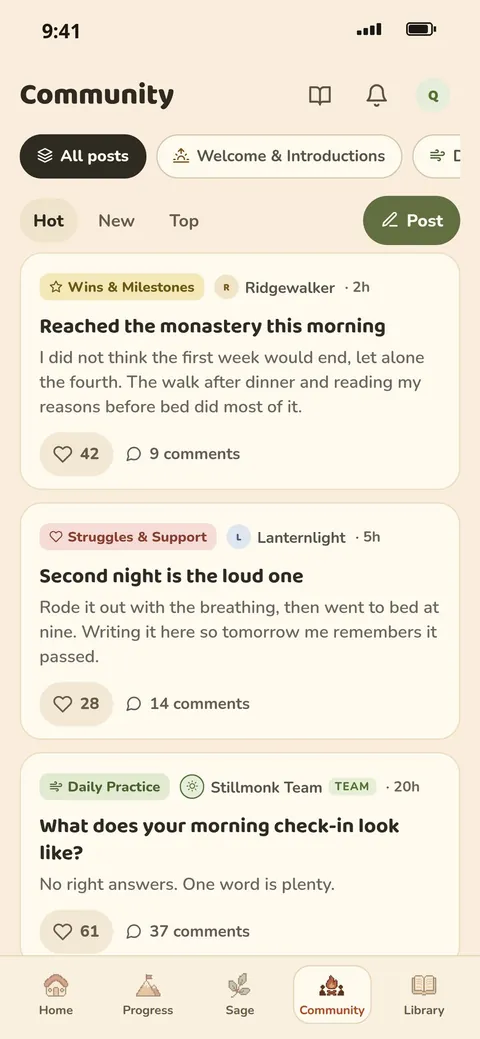
Members share wins, hard days and what helped. Anyone can read it at stillmonk.io/community, without an account, and posts can show up in search results. Posting needs a membership and the same account as the app, and you choose the name others see. Your day count, check-ins and Sage chats are never shown there.
The Stillmonk team reviews reports, which are private. It is not a crisis line.
What it is not
Stillmonk is not therapy, a diagnosis or a treatment, and it does not promise any outcome. It is a calm companion for a hard, private habit. If you want clinical help, please talk to a doctor or a licensed therapist.
The crisis line in the app is chosen on your phone for its region, and one tap calls or texts it. Where there is no verified line for your region, the app shows your local emergency number when it is known, and findahelpline.com. All of it is free and never needs a membership.
Start with today.


For adults. Free to start; an optional membership is billed by Apple or Google. See what it costs or how to cancel.